
A PSA from your (still friendly) commercial photographer and filmmaker:
"Can you just send us all the footage?"
It's a seemingly simple question with a surprisingly complicated answer.
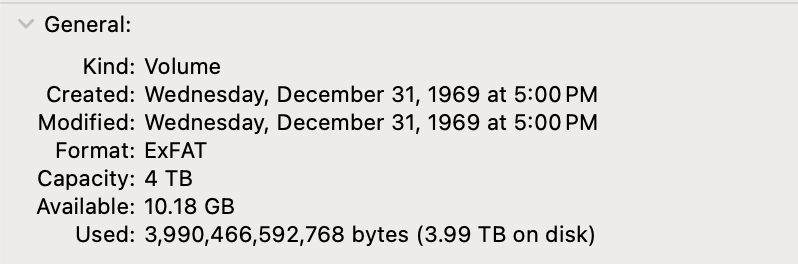
For perspective, a recent commercial production generated approximately one terabyte of 12-bit RAW video footage. Uploading that alone would take over 60 hours on my high-speed internet connection, assuming I didn't need to use the internet for anything else. You know, like running a business.
And that's before we even talk about processing it.
Professional camera footage isn't necessarily ready-to-use content. It's the source material from which we create content. It requires capable hardware, appropriate software, color processing, editing and, most importantly, time.
That beautifully composed five-second shot in your finished commercial might be the result of six takes, intentional lighting, talent direction and a very specific creative objective.
Does your social media manager really have the time to sort through all six takes? Does their computer even have the ability to read the files? Unless they're working with hardware and software capable of handling professional RAW video, they may struggle to simply play them back.
After nearly 15 years in commercial production, one of the biggest shifts I've noticed is the growing expectation that a single production should satisfy every conceivable marketing need.
You want horizontal. You want vertical. You want cinematic. You want candid. You want polished commercial imagery. You want spontaneous, social-first content.
These are different creative briefs and, in many cases, entirely different productions.
You want all the options because, understandably, asking for everything can feel easier than defining exactly what you need.
But keeping every option open doesn't eliminate the need to make creative decisions. It simply pushes those decisions further down the production pipeline, where they often become more time-consuming and expensive.
Diluting the creative scope kills creativity and compromises your team's ability to do their best work.
One of the advantages of working with experienced agencies and established marketing teams is that they understand production begins long before a camera is turned on. The creative brief, intended audience, distribution strategy and deliverables are defined before we arrive on set. Without that foundation, even the most talented production team is left trying to solve strategic problems with a camera.
Every additional objective competes for the same finite production resources: time, attention, personnel and budget. Without expanding those resources, something inevitably suffers.
I also think smartphones, social media and, more recently, AI have fundamentally shifted our perception of what creative work requires.
When an image can be generated in seconds, a video automatically reframed or an object removed with a click, it's easy to develop unrealistic expectations about the time, effort and resources required to produce original commercial content.
I'm not anti-technology. Quite the opposite. I embrace tools that make my work better and my workflow more efficient.
But technology's ability to accelerate execution doesn't eliminate the need for creative direction.
AI cannot authentically document an experience that wasn't captured. A vertical crop doesn't automatically create an intentional vertical composition. And a terabyte of camera footage doesn't equal a terabyte of usable marketing content.
More footage doesn't necessarily mean more useful content.
Can commercial footage be used for social media? Absolutely.
Is repurposing every second of a commercial production for social media an efficient use of anyone's time? Not at all.
If your team needs a library of ready-to-edit footage, let's build that into the production.
If you need high-volume, spontaneous, social-first content, let's bring in a dedicated camera operator using equipment and recording formats suited to that workflow.
If you need premium commercial imagery, let's dedicate our attention to creating exactly that.
These different types of coverage can often happen alongside one another, but that doesn't mean they're the same job. Each requires its own planning, attention, personnel and budget.
Versatility is something we design into a production, not something we should assume comes out of it.
As creative partners, we genuinely want to help you maximize the value of your production investment. The more we understand about your marketing objectives, distribution channels and intended use before we start filming, the better we can accomplish that together.
Defining what you need isn't limiting your creative possibilities. It's giving your creative team the direction necessary to make those possibilities meaningful.
And in an era where technology makes it increasingly easy to create almost anything, perhaps knowing what is worth creating is more valuable than ever.
Let's create more useful content, not simply more footage.
Sincerely,
Your (still friendly) commercial photographer and filmmaker, who would prefer not to turn your social media manager's laptop into a very expensive paperweight or have you spend $800 on a hard drive full of footage you may never use, simply so you can “have it all.”
You know, just in case.