
Stop Confusing Content Creators With Commercial Photographers
I’ve been spending more time in the outdoor and overlanding world lately through my side project, This Way Wild, and I keep hearing versions of the same story from brands. A creator reaches out with a proposition: send me your product and I’ll deliver X number of photos, videos, Reels, posts, whatever. The brand agrees. Then the assets show up late. Or there aren’t enough of them. Or the quality isn’t there. Or the content simply isn’t useful. In the worst cases, nothing shows up at all.
I’ve heard enough of these stories now that I understand the frustration. Brands feel burned because they believed they were making an exchange for a defined result, and what came back looked very different from what they thought they were buying. One company even told me about a creator who received their product, sold it, then accepted the equivalent product from a competing brand and started using that instead. That’s an extreme example, but I think it points to a much bigger issue:
Content creation and commercial production are not the same thing.
Both can be valuable. Both can coexist. Some people are exceptionally good at both. But the industry has blurred the distinction so much that brands routinely hire one and expect the other.
A Curated Feed Is a Highlight Reel
Social media has made this distinction harder to see. I can look at someone’s Instagram feed and see hundreds of beautiful photographs. Perfect campsites. Incredible light. Great locations. Amazing trips. Beautiful products photographed in exactly the right environment.
They may be an incredible photographer, but a curated feed is exactly that. It is a highlight reel.
It proves someone can make great work when the conditions, timing, subject and opportunity come together. It does not automatically prove they can reproduce that result when someone else chooses the product, location, schedule, deadline and desired look.
That is a very different job. I make my living creating the highlights on demand. The location might not be perfect. The weather might change. The light might be terrible. I may only get access to a space at the wrong time of day. The location may look nothing like it did during the scout. The client may need an image that simply does not exist naturally in front of the camera. None of that changes the assignment.
My clients invest in certainty.
Commercial Production Is About Control
I love natural light. I use it constantly, but natural light is the wrong tool if the assignment requires me to guarantee consistency.
That does not make someone who specializes in natural light a lesser photographer. It simply means they may not have spent years studying studio lighting, grip, mixed-light environments, or how to create a particular result when the existing conditions are working against them.
Commercial production is about having enough control to deliver what the project requires. Sometimes that means lighting, diffusion, negative fill or flags. Sometimes it means styling, changing the schedule or compositing. Sometimes it means a producer, assistants, sound, grip, hair and makeup, art direction, a digital tech or an entire crew, and sometimes it means me with an iPhone and a small video light.
That last point matters.
Commercial production is not defined by how expensive the camera is or how polished the image looks.
Sometimes the most commercial decision I can make is to make something feel less commercial.
If the intended use is native social content, the right answer might be an iPhone, available light, handheld movement and a looser, more immediate feel. Not because I can’t do more, but because doing more might actually make the work less effective.
The difference is that the choice is intentional. I can shoot on an iPhone or on a major cinema package. The tool changes. The scale changes.
The responsibility does not. Create what the client needs.
The camera is a tool. The value is knowing which tool to use, why I’m using it, and how to get the result consistently.
“You’ll Receive Whatever I Shoot” Is Not the Same Offer
This may be the simplest way I can explain the distinction.
There is a fundamental difference between:
“You’ll receive whatever I shoot.” and “Let’s create exactly what you need.”
Commercial production starts with questions:
What are we making? Why are we making it? Where will it live? How long does it need to last? What does it need to accomplish? How important is consistency? How much control does the outcome require?
Those answers determine the production.
If the stakes increase, the amount of control can increase with them. That might mean more planning, more time, different equipment, additional crew, styling, location work, post-production or all of the above.
At the higher end, the client can be reviewing what we’re creating while we create it through tethered capture, live galleries or a dedicated client viewing environment. The point is not that every shoot needs all of that.
Commercial production gives us somewhere to go when certainty matters.
Not Every Piece of Content Needs Commercial Production
This distinction cuts both ways. Not every Reel needs a producer. Not every Story needs a lighting package. Not everything needs to be art-directed within an inch of its life. Sometimes loose, fast, imperfect content is exactly what the platform and the audience need.
There is a reason brands have embraced UGC. It can feel immediate. Human. Native to the feed in a way traditional advertising sometimes does not A phone video of someone genuinely using a product can be more effective in the right environment than a beautifully lit commercial ever would be.
That isn’t failed commercial photography. It’s a different tool built for a different job.
Creators can be exceptionally good at that. And when someone has become a trusted voice within a particular community, that matters. If people genuinely trust their recommendations, their opinion can carry enormous value for the right company, but audience value is not the same thing as production value.
Someone can be a phenomenal photographer and still not be the person I would hire to execute a major campaign. Someone can be a brilliant personality and an ideal brand ambassador without being the person responsible for creating the brand’s core visual assets.
Someone can absolutely be both, but they are still different capabilities.
What Happens When Every Brand Starts Doing UGC?
There is another wrinkle here that I think brands should be paying attention to. UGC works in part because it doesn’t initially feel like advertising. It borrows the visual language of real people talking to real people, but what happens when every brand adopts the same formula? Person holding product. Hook in the first two seconds. Problem. Solution. Discount code. Call to action.
Buy, buy, buy.
Eventually the camouflage disappears. It starts feeling like advertising again. Maybe worse, because now the audience can feel the attempt to make the ad look like it isn’t an ad.
There is an authenticity paradox in that: The more brands systematize authenticity, the less authentic it can begin to feel.
We are all being sold to constantly. At some point, that wears people down.
And when every recommendation starts to feel like there is a transaction hiding behind it, brands risk eroding the very thing creators brought to the table in the first place: trust. If everything is content designed to convert, eventually less of it feels worth paying attention to.
That doesn’t mean UGC is dead. It means intended use matters.
Feed-Level Content Cannot Always Solve Brand-Level Problems
This is where I think a lot of brands get into trouble. They see a beautiful feed and assume the person behind it can solve a much larger brand problem, but content that fills a feed and content that builds a brand are not always carrying the same responsibility.
Some content is designed to be consumed today and forgotten tomorrow. There is nothing wrong with that, but the moment an asset has higher aspirations, the standard changes. A homepage. A product launch. Paid media. A campaign. A catalog. A tourism initiative. An image that may represent a company for the next three years. That work needs to do more than generate temporary attention. It has to communicate something consistently enough that the customer begins to understand the brand.
Temporary attention is not the same thing as brand equity.
Virality can be useful. It is not a long-term business strategy.
A brand’s visual language will evolve over time. It should, but the customer still needs to get it. That requires intention.
Product Value Is Not the Same Thing as Cash.
This is another part of the conversation that gets uncomfortable quickly. Product absolutely has value, but product and cash are not the same form of compensation.
If the trade is dinner, the stakes are relatively low. If the product is a $15,000 camper, that is an entirely different business decision.
I’m not interested in telling brands how to structure those agreements. The appropriate level of accountability obviously depends on what is being exchanged, but there is a reason high-value trades deserve more thought than simply handing someone a product because their feed looks good.
My relationship with Radica is a good example. I originally sought them out because I wanted a way to escape the Arizona heat in the summer and potentially open up new work markets during a time of year when commercial production here often slows down. I didn’t ask them to bet on me because of my audience. I didn’t have one. They gave me an opportunity to get into one of their campers, but I still invested in it myself. I had skin in the game. Then I did the work. I proved what I could create. Only after that did the relationship begin opening into something larger and more long-term. That experience reinforced something I already understood from commercial production:
Trust is earned through delivery.
There Is No Substitute for Experience
There is no substitute for tens of thousands of hours.
There is no substitute for working with mentors.
There is no substitute for being on set.
I have systems in place because I have spent years doing this over and over again. Those systems are not reserved for giant production days. They are baked into the way I work. If I photograph a major campaign, there is a process. If I’m working alone on a small documentary-style assignment, there is a process. Even if I happen to take photographs of friends and create something valuable to them, the habits are still there. Capture. Protect the work. Organize it. Process it. Deliver it. Commercial experience creates repeatability.
and repeatability is a huge part of certainty.
That experience also teaches things that do not show up in a portfolio: how to solve problems quickly, how to communicate when the clock is running, how to know when to push and when to simplify, how to protect the result when time starts disappearing, and how to collaborate, and, importantly, how to recognize when the best thing I can do for a client is not try to do everything myself.
Commercial Production Is a Team Sport
If a project has the budget for a producer, I want a producer. Trying to produce the shoot, coordinate logistics, manage talent, monitor the schedule, solve every production issue and simultaneously give the photography my full attention would be a massive disservice to the client.
Commercial productions work because people specialize. The analogy I keep coming back to is a professional kitchen.
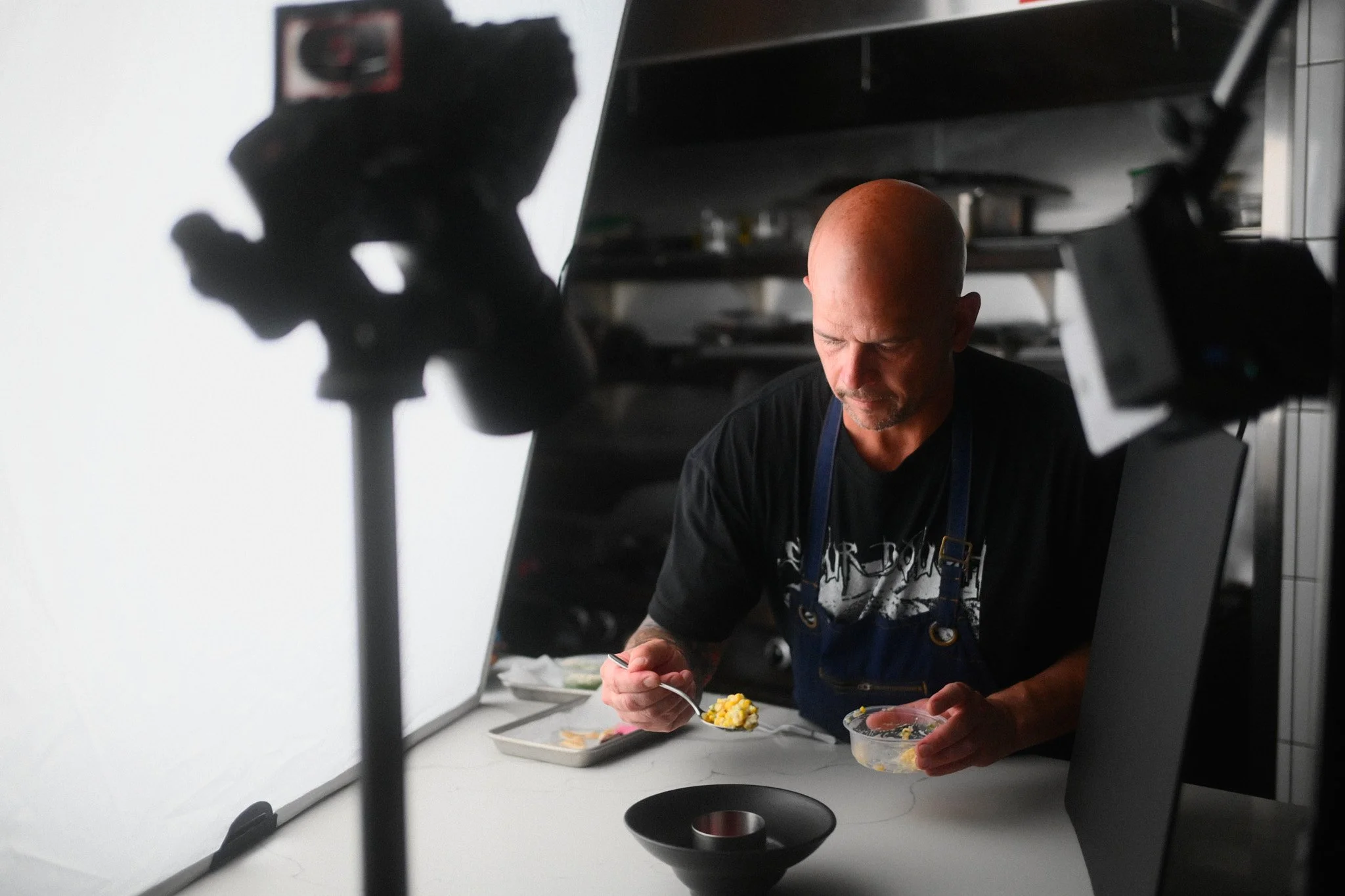
The executive chef does not stand at every station simultaneously trying to cook every component of every dish. Different cooks own different stations. They focus on their responsibilities. Then the executive chef can concentrate on making sure every plate leaving the kitchen meets the standard. Production works the same way.
When everyone can focus on the job they are actually there to do, the end result gets exponentially better.
It always comes back to the same fundamental questions:
How important is the asset?
How much control does it need?
How long does it need to live?
The production should scale accordingly.
Choose the Right Tool for the Job
I do not think the answer is “brands should stop working with creators.” That completely misses the point.
Creators can bring enormous value. Commercial photographers and production companies bring enormous value. Sometimes the same person can legitimately operate in both worlds. I can scale KPL all the way down to a one-person, documentary-style production with an iPhone if that is the right answer. I can also scale it upward into a full commercial production when the project, expectations and stakes require more control. What changes is the production. What does not change is my responsibility for the result.
So the mistake is not hiring a content creator. The mistake is looking at a highly curated social feed and assuming it proves commercial-production capability. It might. It might not. A pocketknife is incredibly useful but I would not buy one and then get angry because it will not split firewood. The tool was never the problem. The expectation was.
Before anything gets hired, produced or traded, the questions are still remarkably simple: What are we making? Why are we making it?
The answer tells us almost everything else.
I’m not interested in pretending content creators and commercial photographers are interchangeable just because we both make pictures.
They are different disciplines and both can be valuable, but when the asset matters, when the outcome needs to be repeatable, and when failure is not really an option, the difference matters too.
My Clients Invest in Certainty
Great work. An easy process. Delivered when I said it would be. Every single time.
Everything else is production.